Do you dream of learning Arabic? Do you think it is too hard, or that you do not have enough time? The truth is: thousands of people around the world learn Arabic every year — starting from zero. And you can do it too.
Arabic is the 5th most spoken language in the world. More than 420 million people speak it. It is the language of the Quran, the language of a rich culture, and a very valuable skill for your career. Many people search for: 'How long does it take to learn Arabic?' or 'Is Arabic hard to learn?' The answer depends on your plan. With the right plan, 6 months is enough to reach a conversational level.
In this article, you will find a clear, practical 6-month plan. Each month has specific goals. This plan works for complete beginners — you do not need to know any Arabic before you start.
Why Learn Arabic?
Arabic opens doors to: the Quran and Islamic studies, Arab culture and history, business opportunities in the Middle East, travel to 22 Arabic-speaking countries, and career opportunities in international organisations like the UN. Arabic is also one of the 6 official UN languages.
Month 1 | The Alphabet & Sounds | الحروف
🎯 Goal: You will learn all 28 Arabic letters. You will know how to read and write them.
💡 Why this month matters: Arabic is a phonetic language. This means each letter always makes the same sound. Once you learn the letters, you can read any Arabic word — even if you do not understand the meaning yet.
Learn letter shapes: Each Arabic letter has 3 or 4 different shapes depending on its position in the word (at the start, middle, or end).
Learn the sounds: Some Arabic sounds do not exist in English. For example: ع (a deep throat sound), غ (like a soft gargle), ح (a strong 'h' from the throat). Use audio resources to practise.
Daily practice: Study for 20–30 minutes every day. Write the letters by hand — this helps your brain remember them.
Good tools: Use YouTube channels like 'Arabic with Sam' or 'ArabicPod101', or apps like 'Alif Baa' to learn the alphabet with audio.
Month 2 | Basic Vocabulary & Simple Sentences | المفردات
🎯 Goal: You will learn 200–300 of the most common Arabic words and use them in simple sentences.
💡 Why this month matters: You do not need thousands of words to start speaking Arabic. Research shows that the 300 most common words cover about 65% of everyday conversation. Start with what you really need.
Vocabulary categories: Learn: numbers (أرقام), colours (ألوان), family members (أفراد الأسرة), days of the week (أيام الأسبوع), food (طعام), greetings (تحيات), and common verbs like: go (يذهب), eat (يأكل), want (يريد).
Use flashcard apps: Anki is the best free app for vocabulary. It uses 'spaced repetition' — it shows you each word at the perfect time for your brain to remember it.
Learn in context: Do not just memorise word lists. Learn each word in a sentence. For example: not just 'باب = door', but 'البابُ مفتوح = The door is open'.
Daily goal: Learn 10–15 new words every day. Review old words for 10 minutes before learning new ones.
Month 3 | Basic Grammar — Simplified | القواعد
🎯 Goal: You will understand the basic rules of Arabic grammar and use them to make your own sentences.
💡 Why this month matters: Many learners are afraid of Arabic grammar. But you do not need to learn everything. Focus only on the basics first — you can learn the details later.
The nominal sentence (الجملة الاسمية): This is a sentence without an action word. Example: البيتُ كبيرٌ = The house is big. In Arabic, you do not need the verb 'is' — you just put two words together.
The verbal sentence (الجملة الفعلية): This is a sentence with an action. Example: ذهبَ أحمدُ إلى المدرسةِ = Ahmad went to school. The verb usually comes first in Arabic.
Masculine and feminine: Arabic words are either masculine (مذكر) or feminine (مؤنث). Most feminine words end in 'ة' (ta marbuta). Example: مُعلِّم = male teacher, مُعلِّمة = female teacher.
Do not memorise — practise! After learning each rule, immediately write 5 sentences using that rule. This is how grammar becomes natural.
Month 4 | Listening & Speaking | الاستماع والكلام
🎯 Goal: You will start understanding spoken Arabic and speaking your first real sentences.
💡 Why this month matters: Many learners can read Arabic but cannot understand when someone speaks fast. Month 4 is all about training your ears and mouth.
Listen every day: Find 15–20 minutes every day to listen to Arabic. You do not need to understand everything. Just listen. Good resources for beginners: 'News in Slow Arabic', short Islamic lectures with subtitles, Arabic children's songs and stories.
Speak out loud: This sounds strange, but it works: talk to yourself in Arabic. Describe what you see around you. Say: 'This is a table. The table is brown. There is a book on the table.'
Find a language partner: Use apps like HelloTalk or iTalki to find native Arabic speakers who want to learn your language. You practise Arabic — they practise English.
Record yourself: Use your phone to record yourself speaking Arabic. Listen back. You will notice your own mistakes and improve fast.
Month 5 | Reading Real Texts | القراءة
🎯 Goal: You will read simple real Arabic texts and understand the main ideas.
💡 Why this month matters: After 4 months of hard work, you are ready to read real Arabic. This is a very exciting step — it shows you how much you have learned.
Start with graded readers: Look for 'Arabic graded readers' or 'Arabic easy stories for beginners' online. These are texts written specially for learners at your level.
Do not stop at every word: When you see a word you do not know, try to guess the meaning from the context first. Only use the dictionary if you really need to.
Read Islamic texts: If you are learning Arabic for the Quran, start reading short surahs you already know. Try to understand the Arabic words directly — without the translation.
Track your vocabulary: Keep a notebook of new words you find while reading. Try to use each new word in a sentence of your own.
Month 6 | Put It All Together | التكامل
🎯 Goal: You will use all your skills together — reading, writing, listening, and speaking — in real situations.
💡 Why this month matters: Month 6 is the 'graduation month'. You are not a beginner anymore. Now it is time to use Arabic in the real world.
Have real conversations: Book sessions on iTalki with an Arabic tutor. Tell them about your life, your interests, your work. Make mistakes — this is how you learn.
Write in Arabic every day: Start a simple Arabic journal. Write 2–3 sentences each day. Example: 'Today I woke up at 7. I ate breakfast. The weather was sunny.'
Watch Arabic media: Start watching Arabic YouTube channels or Arabic TV shows with Arabic subtitles (not English subtitles). Try Al Jazeera's learning channel or Arabic cartoons.
Celebrate your progress: Look back at where you started 6 months ago. You can now read, write, speak basic sentences, and understand simple conversations in Arabic. This is a huge achievement!
- Your 6-Month Progress Roadmap
- Month
- Arabic Goal
- English Goal
Month 1
- تعلم الحروف الـ٢٨ وأصواتها
- Learn all 28 letters and their sounds
Month 2
- ٣٠٠ كلمة أساسية + جمل بسيطة
- 300 core words + simple sentences
Month 3
- القواعد الأساسية: الجملة الاسمية والفعلية
- Basic grammar: nominal & verbal sentences
Month 4
- فهم اللغة المنطوقة + المحادثة الأولى
- Understand spoken Arabic + first conversations
Month 5
- قراءة نصوص حقيقية + ٨٠٠ كلمة
- Read real texts + 800-word vocabulary
Month 6
- استخدام العربية في مواقف حقيقية
- Use Arabic in real-life situations
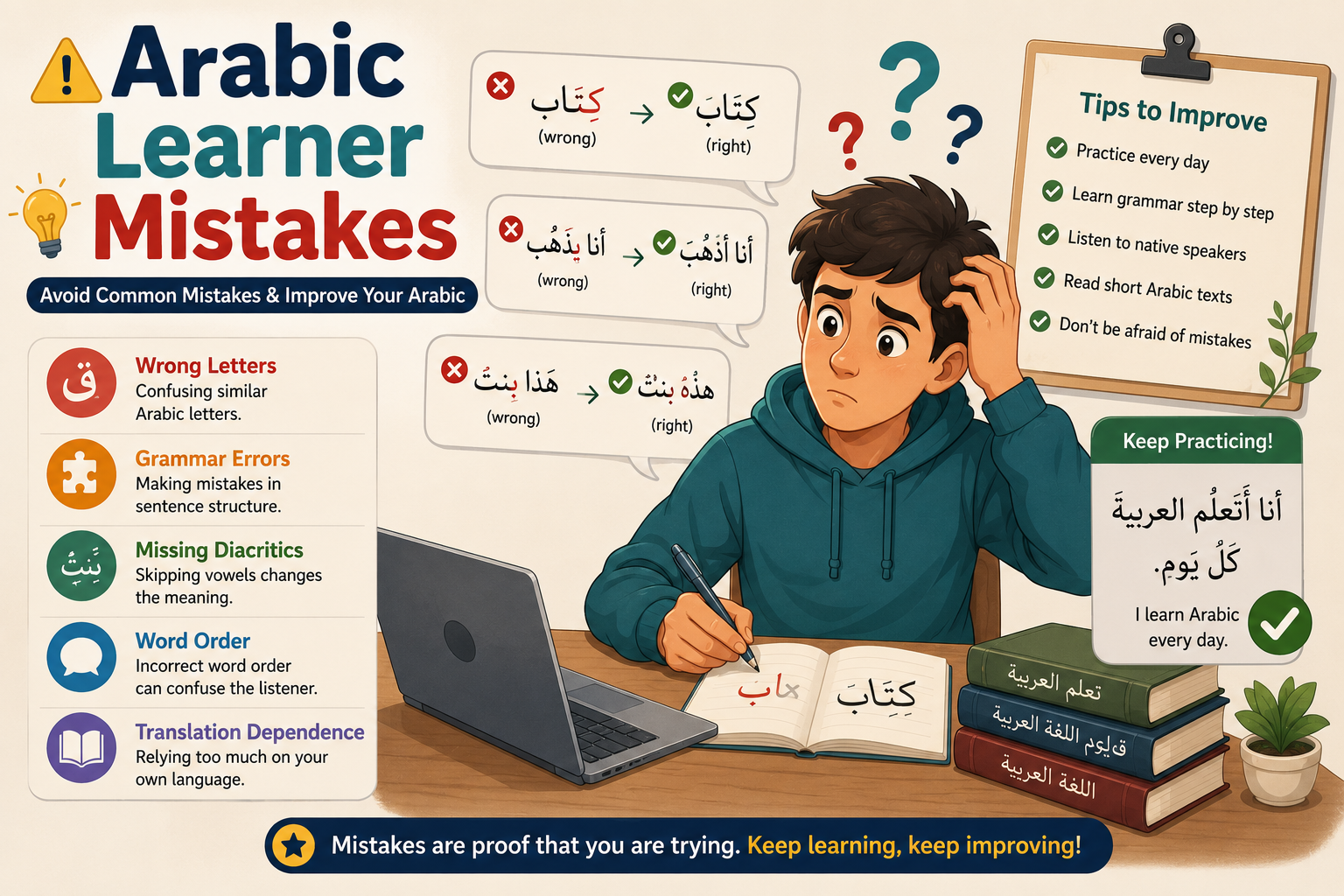
- 5 Common Mistakes Arabic Learners Make (And How to Avoid Them)
Trying to learn everything at once. Arabic has a lot of grammar. But you only need the basics to start speaking. Learn one rule at a time. Practise it. Then move to the next.
Only studying — never speaking. Many learners can read Arabic perfectly but cannot say one sentence out loud. Speak Arabic every day, even if it is just 5 minutes.
Choosing the wrong type of Arabic. There are many types of Arabic: Classical Arabic (فصحى), Modern Standard Arabic (MSA), and dialects (Egyptian, Gulf, Levantine, etc.). For beginners, start with Modern Standard Arabic (MSA). It is used in books, news, and the Quran.
Giving up too early. Month 2 and month 3 are the hardest. Many learners quit here. If you feel stuck, do not stop. Just slow down. Even 10 minutes of Arabic per day is better than nothing.
Not using audio resources. Arabic has sounds that you cannot learn from a book. You must hear them and repeat them. Always combine reading with listening.
- Frequently Asked Questions (FAQ)
Q: How long does it take to learn Arabic?
A: For English speakers, Arabic is one of the harder languages to learn. The US Foreign Service Institute (FSI) estimates about 2,200 hours for full professional fluency. But you can reach a conversational level in 6–12 months with 30–60 minutes of daily study.
Q: Is Arabic hard to learn for English speakers?
A: Arabic is different from English in many ways: it uses a different script, reads right to left, and has sounds that do not exist in English. But the grammar is very logical and regular — which makes it easier than it looks!
Q: Should I learn Arabic or a dialect?
A: Start with Modern Standard Arabic (MSA). It is understood across all Arab countries. After you have a strong base in MSA, you can easily pick up any dialect you need.
Q: Can I learn Arabic for the Quran without speaking Arabic?
A: Yes. 'Quranic Arabic' is a specific type of Arabic. Many learners focus only on understanding the Quran. You can start with a Quranic Arabic course and learn basic vocabulary and grammar specially used in the Quran.
Q: What is the best app to learn Arabic?
A: For vocabulary: Anki (free) or Mango Languages. For grammar: Pimsleur or ArabicPod101. For Quran Arabic: Bayyinah TV or Quranic (app). For conversation practice: iTalki or HelloTalk.
- 50 Essential Arabic Words for Beginners
Learn these first — they are used in almost every Arabic conversation.
- Arabic
- English
- Arabic
- English
- Arabic
- English
- مرحباً / أهلاً
- Hello / Welcome
- نعم
- Yes
- لا
- No
- 1–3
- شكراً
- Thank you
- من فضلك
- Please
- آسف
- Sorry
- 4–6
- أنا
- I / Me
- أنتَ / أنتِ
- You (m/f)
- هو / هي
- He / She
- 7–9
- بيت
- House
- مدرسة
- School
- مسجد
- Mosque
- 10–12
- كبير
- Big
- صغير
- Small
- جديد
- New
- 13–15
- ذهب
- He went
- أكل
- He ate
- قال
- He said
- 16–18
- يوم
- Day
- أسبوع
- Week
- سنة
- Year
- 19–21
- ماء
- Water
- طعام
- Food
- كتاب
- Book
- 22–24
- الله
- God / Allah
- إسلام
- Islam
- قرآن
- Quran
- 25–27
- CONCLUSION
Start Today — Your Arabic Journey Begins with One Letter
Learning Arabic in 6 months is not just possible — it is achievable for anyone who follows a clear plan and studies consistently. You do not need to be a language genius. You just need a good plan, the right resources, and 20–30 minutes every day.
Arabic is one of the most beautiful, rich, and rewarding languages in the world. When you read the Quran in Arabic, understand an Arabic song, or hold your first real conversation with a native speaker — that feeling is impossible to describe. It makes every difficult moment worth it.
"The best time to start learning Arabic was yesterday. The second best time is today. Begin with Alef. Just one letter."
- 🚀
Ready to Start?
Join our online Arabic learning platform and get access to structured Arabic courses for all levels, live sessions with certified native-speaking teachers, personalised 6-month learning plans, Quran and Islamic Arabic programmes, and a supportive community of Arabic learners worldwide. Start your free trial today!
Published on an accredited Arabic language e-learning platform. All content reviewed by certified Arabic language instructors. | 2026