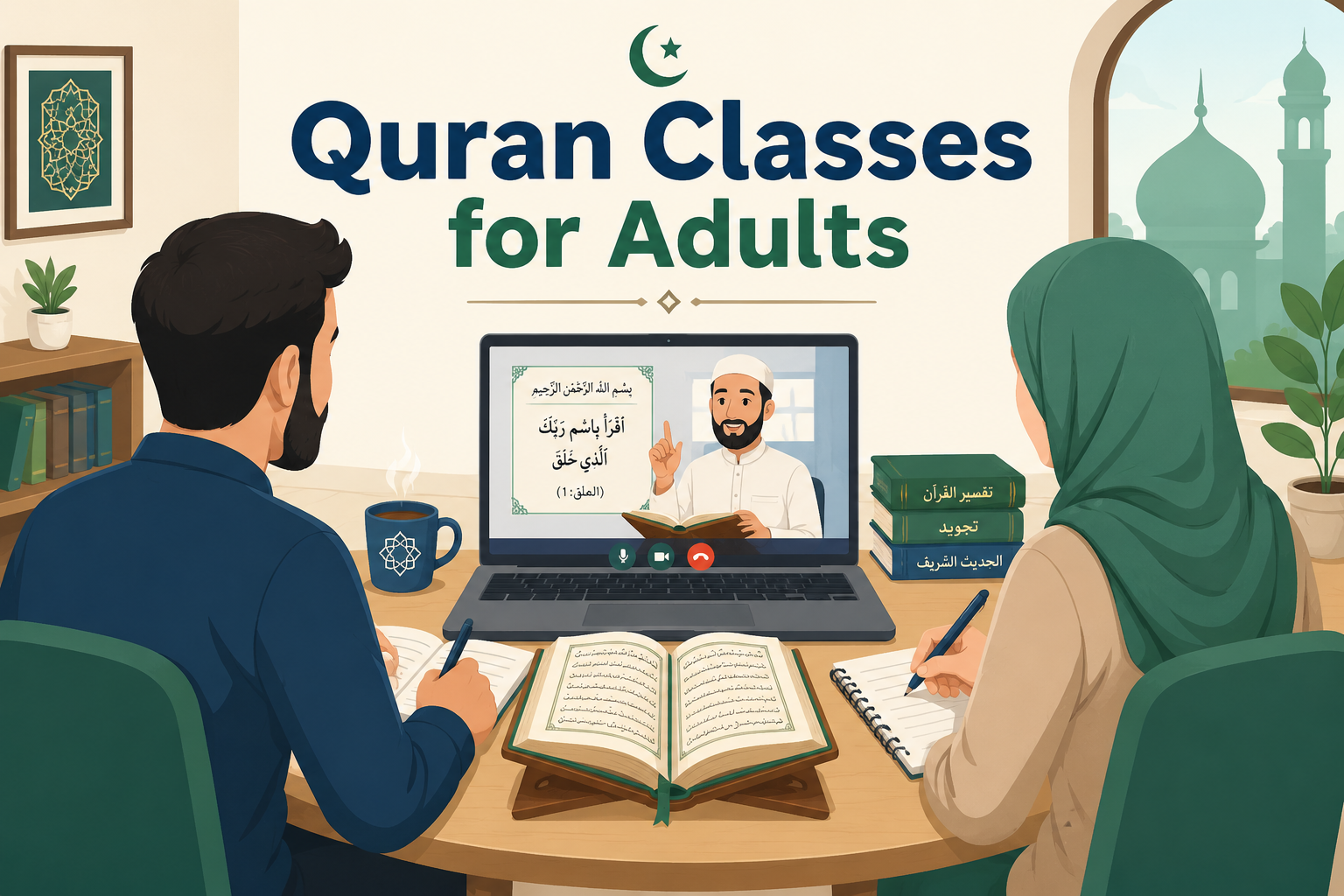
Many adult learners delay Quran study because they imagine that confident reading belongs only to those who started young. In practice, the opposite is often true: adults usually progress well when the path is calm, structured, and free from shame. What they need first is not pressure. They need a clear opening map, a patient teacher, and a routine that turns every lesson into one visible step forward.

Start with dignity before speed
The first success for an adult beginner is emotional, not technical. A learner who feels safe to pause, repeat, and ask questions will stay long enough to improve. A learner who feels embarrassed will often disappear before the real work even begins. For that reason, the first weeks should feel simple and steady. The target is correct sound recognition, short guided reading, and a clear memory of what was improved in each lesson.
Many teachers rush directly into correction after correction. A better opening is to narrow the field: a small reading passage, two or three recurring sound challenges, and one practical homework instruction. Adults respond well when the lesson ends with a sentence such as: today you improved long vowels, the articulation of two letters, and the transition between short phrases. Precision builds confidence.
A six-week entry plan that feels realistic
In a healthy beginner plan, week one is about orientation: what the learner already knows, where hesitation appears, and how correction will be delivered. Weeks two and three should reduce noise. Read less, but read with more attention. Weeks four and five should introduce repetition with purpose, so the learner hears the same corrected patterns often enough to trust the tongue. By week six, the learner should be able to see progress in a short recorded comparison, a smoother passage, or reduced dependence on prompts.
- Week 1: identify the strongest and weakest sound patterns.
- Week 2: build a short daily reading habit of ten to fifteen minutes.
- Week 3: repeat selected phrases until hesitation drops.
- Week 4: connect tajweed reminders only to patterns that actually appear in reading.
- Week 5: ask the learner to self-notice two mistakes before the teacher names them.
- Week 6: review a passage from the first week and compare fluency.

What a strong lesson sounds like
Good adult instruction sounds slower than people expect. The teacher leaves room for the learner to think, attempts are not interrupted too early, and correction is focused rather than scattered. A strong lesson also uses language that protects energy: try that again from the middle, keep the long vowel open, return to the first word, now compare the two readings. Short, exact prompts are better than long speeches.
It also helps to separate reading skill from memorization goals. Many adults become discouraged because they think they must improve every part of Quran study at once. Reading confidence usually rises faster when memorization pressure is reduced at the beginning. Once the page feels less intimidating, memorization becomes a reward rather than a threat.
A short reflection and recitation video
The video below adds a reflective Quran touch to the topic and can support the reader with a calm recitation-centered pause inside the article.
Simple homework that adults actually complete
Homework should feel light enough to repeat, not heavy enough to postpone. A practical model is one marked passage, one sound focus, and one instruction on how to listen back. For example: read this paragraph three times, circle every place where the long vowel appears, and record the third reading. Homework becomes more powerful when the teacher opens the next lesson by referring to one specific improvement from that recording.
A mature learner can become a confident Quran reader when the first stage is built on dignity, repetition, and visible progress. The goal is not to impress in the first week. The goal is to remain steady long enough for reading to become familiar, then beautiful, then strong.